
“Enhancing Environmental Data Transparency and Proactively Participating in the Carbon Market”
Shortly after Vietnam’s domestic carbon exchange commenced operations, Deputy Prime Minister Nguyen Van Thang called on the business community to review production technologies, improve environmental data transparency and proactively participate in the carbon market. Businesses are considered a decisive driving force behind the success of Vietnam’s pathway towards net-zero emissions by 2050.
Green transition and ESG are business imperatives

Speaking at the Energy and Environment Forum on the morning of 8 July, Deputy Prime Minister Nguyen Van Thang stressed that businesses across all economic sectors would play a decisive role in determining the success of Vietnam’s net-zero pathway. According to the Deputy Prime Minister, businesses should regard the green transition and ESG management as strategic imperatives—not only as a means of meeting environmental standards, but also as an opportunity to strengthen competitiveness.
Three specific requirements were highlighted: review production technologies, conduct greenhouse gas inventories and ensure environmental data transparency while proactively participate in the carbon market. Over the longer term, businesses should take the lead in developing emissions-reduction roadmaps and integrating ESG criteria into their corporate strategies. The Deputy Prime Minister also reaffirmed the Government’s consistent position that economic growth must not come at the expense of the environment.
Echoing this view, Deputy Minister of Agriculture and Environment Le Cong Thanh noted that green standards, carbon markets, green finance and green supply chains are creating new rules for global trade. A carbon exchange serves as an instrument for supporting emissions-reduction targets, enabling businesses to participate proactively in carbon allowance and credit trading and offsetting mechanisms, while potentially improving their access to green finance in the future.
Carbon market: Emission allowances become corporate assets
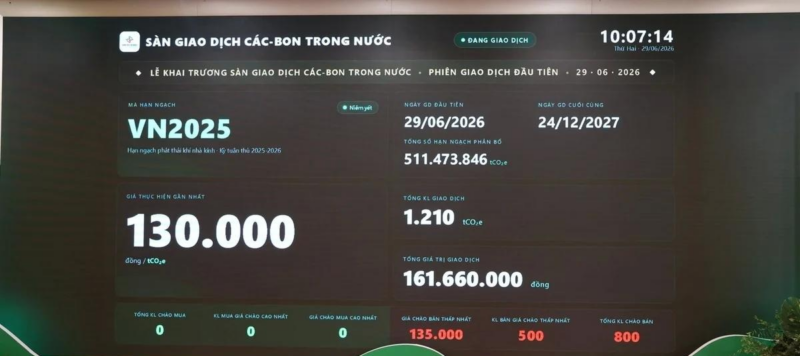
Vietnam’s domestic carbon exchange officially commenced operations on 29 June 2026 at the Hanoi Stock Exchange, or HNX, under the allowance code VN2025. The first allowance trading lot was recorded with a minimum offering price of VND 135,000. The trading period will continue until 24 December 2027, with a total of 511,473,846 emission allowances allocated. According to expert estimates, the total notional market value is approximately VND 66.5 trillion.
This operating mechanism places emissions within a financial and compliance framework. Businesses whose verified emissions remain below their allocated allowances may sell the surplus. Conversely, businesses whose emissions exceed their allocated allowances must purchase additional units to fulfil their compliance obligations. Whether carbon becomes a cost or a source of revenue therefore depends heavily on the quality of the company’s greenhouse gas inventory data and the emissions-reduction roadmap it develops today.
Facilities included in the allowance allocation scheme must consequently maintain rigorous and continuous greenhouse gas accounting throughout the year. Accurate emissions data enables them to determine whether they should buy or sell allowances, protect their commercial interests and optimise compliance costs.
Where should businesses begin?
A business cannot trade what it has not measured. The essential first step is to conduct a greenhouse gas inventory in accordance with ISO 14064-1 and the GHG Protocol, while complying with Decree No. 06/2022/ND-CP and Decree No. 119/2025/ND-CP. Reliable Scope 1 and Scope 2 emissions data are required to compare actual emissions against allocated allowances. Based on the inventory results, businesses can identify the gap between actual emissions and their allowance position and quantify potential compliance-cost exposure.
An emissions-reduction roadmap can then be developed with specific measures, including:
- Improving energy efficiency.
- Switching to lower-carbon fuels.
- Procuring renewable electricity through I-REC certificates.
- Applying circular economy models.
- Deploying carbon emissions-reduction technologies.
Businesses can subsequently determine their intended position in the market, whether by buying or selling allowances, developing carbon credit projects, or preparing for the Carbon Border Adjustment Mechanism, or CBAM, if they export goods to the European Union.
CIC supports businesses on their net-zero journey
CIC Construction Technology and Consultancy Joint Stock Company provides a comprehensive ecosystem of services to help businesses prepare for participation in the carbon market, including:
- Facility-level greenhouse gas inventories.
- Greenhouse gas mitigation reporting.
- Carbon credit and carbon market advisory services.
- I-REC renewable energy certificates.
- LCA, EPD and CBAM consulting.
- Green building consulting.
- Carbon emissions-reduction technology solutions.
Supported by an experienced team of specialists and practical project experience across emissions-intensive sectors such as thermal power, steel, cement, textiles and construction, CIC is committed to delivering practical value and helping businesses translate commitments into measurable action based on accurate and verifiable data.
For further information about the carbon market, Vietnam’s carbon exchange and greenhouse gas inventory services, please contact CIC Construction Technology and Consultancy Joint Stock Company via the hotline 0866 059 659.
References: VnExpress, Government News, VnEconomy, 8 July 2026; netzero2050.vn, 29 June 2026.

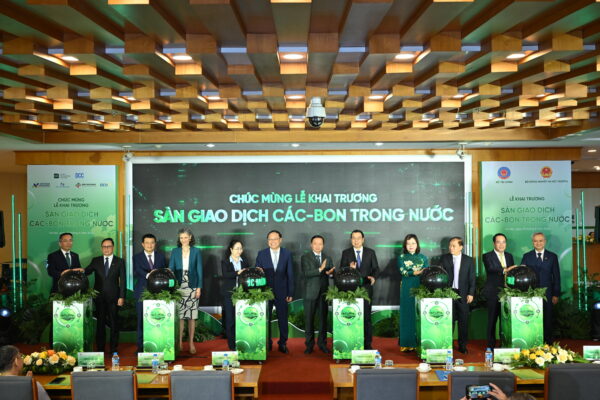
Domestic Carbon Exchange Officially Comes into Operation