

Lessons from the World Bank’s USD 56.5 Million Payment and the Future of Vietnam’s Carbon Exchange
The transfer of 11.3 million tonnes of CO₂ emission reductions from Vietnam’s North Central Region generated USD 56.5 million in revenue from the World Bank. This transaction represents not only one of Southeast Asia’s largest forest finance milestones, but also an important stepping stone when considered alongside Decree No. 180, which takes effect in July 2026 and is expected to shape the pricing mechanism and infrastructure required for a pilot domestic forest carbon credit exchange.
1. The USD 56.5 Million Milestone: A Results-Based Payment
According to the latest information from Vietnam’s Department of Forestry and Forest Protection, Vietnam has officially received USD 56.5 million, equivalent to more than VND 1.4 trillion, from the World Bank.The payment covers a total of 11.3 million tonnes of verified CO₂ emission reductions generated from forests across six provinces in the North Central Region: Thanh Hoa, Nghe An, Ha Tinh, Quang Binh, Quang Tri and Thua Thien Hue.
Under the original financial agreement with the World Bank’s Forest Carbon Partnership Facility, or FCPF, Vietnam transferred 10.3 million tonnes of emission reductions and received USD 51.5 million. Following forest protection outcomes that exceeded the initial target, Vietnam transferred an additional one million tonnes of CO₂ emission reductions and received a further USD 5 million. The average price therefore remained fixed at USD 5 per tonne of CO₂.
How has the funding been allocated?
Unlike conventional upfront investment grants, this funding represents a “results-based payment” linked to verified emission reductions. To date, the proceeds have been distributed through a transparent allocation mechanism.
More than 70% of the funding, benefiting nearly 80,000 recipients, has been transferred directly to forest owners, including households, individuals, organisations and forest-dependent local communities. Approximately half of the beneficiaries are members of ethnic minority groups in Thanh Hoa, Nghe An, Ha Tinh, Quang Tri and Hue City. This is one of the largest subnational forest carbon transactions in Southeast Asia. The payment also marks another step towards the development of a stronger carbon market in Vietnam.
Forests are critical to Vietnam’s net-zero target
Vietnam regards forests as one of its most important climate assets. At the COP26 Climate Conference, Vietnam committed to achieving net-zero emissions by 2050.
Vietnam also raised its climate ambition in its updated Nationally Determined Contribution, or NDC. The country aims to reduce greenhouse gas emissions by 15.8% by 2030 using domestic resources. With international support, this reduction could rise to 43.5% compared with the business-as-usual scenario.
The remaining proceeds are allocated to the Forest Protection and Development Fund to support forest monitoring, law enforcement and sustainable livelihoods aimed at preventing forest degradation.
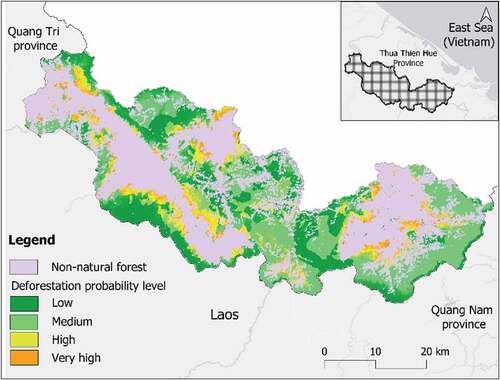
Deforestation probability map for the study area covering Quang Tri and Thua Thien Hue.
2. Why High-Quality Forest Carbon Credits Are in Demand
Vietnam’s latest payment comes at a time when global demand for high-quality forest carbon credits continues to increase.
Companies are facing growing pressure to reduce emissions and invest in credible climate projects. Buyers are becoming more selective and increasingly favour carbon credits supported by robust scientific methodologies, independent verification and clearly demonstrated benefits for local communities.
Forest carbon credits remained the largest segment of the voluntary carbon market, or VCM, in 2026, accounting for 37% of all retired credits. More than ever, however, buyers are focusing on credit quality, transparency and project integrity.
According to Sylvera data, total credit retirements across the VCM ranged from 168 million to 173 million credits. This suggests that approximately 62 million to 64 million forest carbon credits were permanently retired by end users in 2025.
3. The Forest Carbon Credit Market
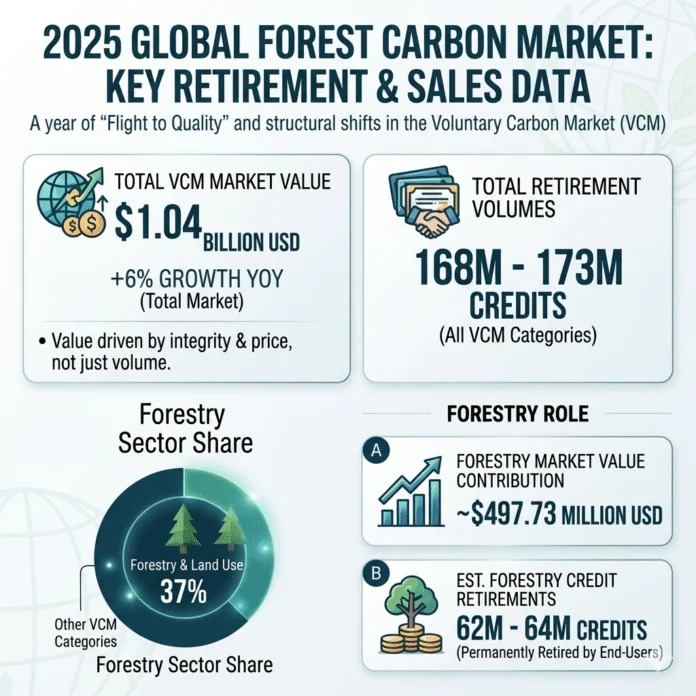
Global forest carbon market data for 2025. Sources: Sylvera Carbon Markets Report; AlliedOffsets VCM Review; Ecosystem Marketplace State of the Voluntary Carbon Markets data; Market Growth Report on voluntary forestry carbon offsets.
Jurisdictional forest carbon programmes such as Vietnam’s are expected to benefit from this trend. These programmes measure emissions across large geographical areas rather than within individual project boundaries. This approach can improve transparency and reduce the risk of double counting.
Vietnam joins a growing list of countries that have received results-based payments through FCPF Emission Reductions Payment Agreements, or ERPAs. Since its establishment, the FCPF has supported 47 developing countries and mobilised approximately USD 1.3 billion to reduce emissions from deforestation and forest degradation. Other countries that have successfully participated include Mozambique and the Dominican Republic.
Costa Rica, Chile, Ghana, Guatemala, Lao PDR, Nepal and Indonesia have also signed ERPAs worth millions of US dollars. These agreements demonstrate the critical role of results-based forest finance in protecting forests, supporting rural livelihoods and contributing to national climate targets.
4. Forests and the Nationally Determined Contribution
One strategically and legally significant detail that businesses should note is that, under the pilot transfer agreement between Vietnam and the FCPF, 95% of the emission reductions remain available to Vietnam for the implementation of its Nationally Determined Contribution. The NDC represents Vietnam’s greenhouse gas mitigation commitment under the Paris Agreement and forms part of the country’s pathway towards net-zero emissions by 2050.
This means Vietnam can attract international climate finance while retaining the right to account for most of the emission reductions towards its national climate objectives. The Department of Forestry and Forest Protection has also emphasised that future sales of carbon credits and emission reduction outcomes may only proceed after ensuring that Vietnam’s national NDC commitments can still be fulfilled.
5. The Global VCM Price Landscape: Where Do Nature-Based Credits Stand?
Although the World Bank FCPF price of USD 5 per tonne of CO₂ provides a stable benchmark for the pilot phase, high-quality nature-based credits can command substantially higher prices in the international voluntary carbon market.
According to pricing analyses from MSCI and data from Sylvera, major global corporations may be willing to pay between USD 40 and USD 50 per credit for forestry projects supported by rigorous due diligence, transparent monitoring systems and clearly demonstrated community impacts. This price range is eight to ten times higher than the baseline price commonly used in bilateral international forest finance agreements.
Why is Vietnam’s jurisdictional model highly regarded?
Unlike standalone projects, which may face risks relating to additionality or emissions leakage, Vietnam’s model measures emission reductions across an entire jurisdiction comprising six participating provinces.
This approach offers several advantages:
- Reducing double-counting risks: Credit flows can be monitored consistently through a national data and accounting system.
- Supporting long-term permanence: The programme is backed by government forest management policies and broad participation from local communities.
6. Vietnam’s Legal Framework: Preparing for a Larger Market
July 2026 marks a significant turning point for Vietnam’s domestic carbon market, when Decree No. 180 on forest carbon sequestration and storage services officially takes effect. Implementation guidance and a national forest carbon credit standard are also expected to be issued.
The new legal framework is expected to provide specific provisions on:
- Clearly identifying providers and users of forest carbon sequestration services.
- Standardising procedures for developing, measuring and registering forest carbon projects in line with international requirements.
- Paving the way for Vietnam’s pilot carbon exchange before the market is expanded into a more comprehensive compliance-based system towards the end of the decade.
Comparison of Vietnam’s Forest Carbon Market Scenarios
| Criterion | FCPF–World Bank pilot phase | Market-based trading and exchange development under Decree No. 180 |
|---|---|---|
| Pricing mechanism | Fixed price of USD 5 per tonne of CO₂ | Prices determined through commercial negotiation or exchange-based auctions. High-quality credits in the voluntary carbon market may reach approximately USD 40–50 per credit. |
| Buyers | International financial institutions, notably the World Bank through the FCPF | Multinational corporations with substantial emissions in sectors such as steel, cement and energy, as well as independent investment funds |
| NDC treatment | Vietnam retains 95% of the emission reductions for use towards its national NDC | Transactions must comply with allocated allowances, offset-use limits and national approval requirements to safeguard NDC implementation |
Conclusion
The USD 56.5 million received from the World Bank for the transfer of forest carbon emission reductions provides clear evidence that forest protection in Vietnam can generate direct and sustainable economic value. The next major challenge for regulators and forest owners will be to strengthen carbon accounting and auditing capacity while ensuring transparency under the new requirements introduced by Decree No. 180.
As international buyer confidence is reinforced through accurate scientific data, robust monitoring and credible verification, green finance flowing into Vietnam’s forests may extend far beyond tens of millions of US dollars and become an important pillar of the country’s broader net-zero economy.
This article draws on global forest market analysis published by Carbon Credits and implementation data from Vietnam’s Department of Forestry and Forest Protection.