

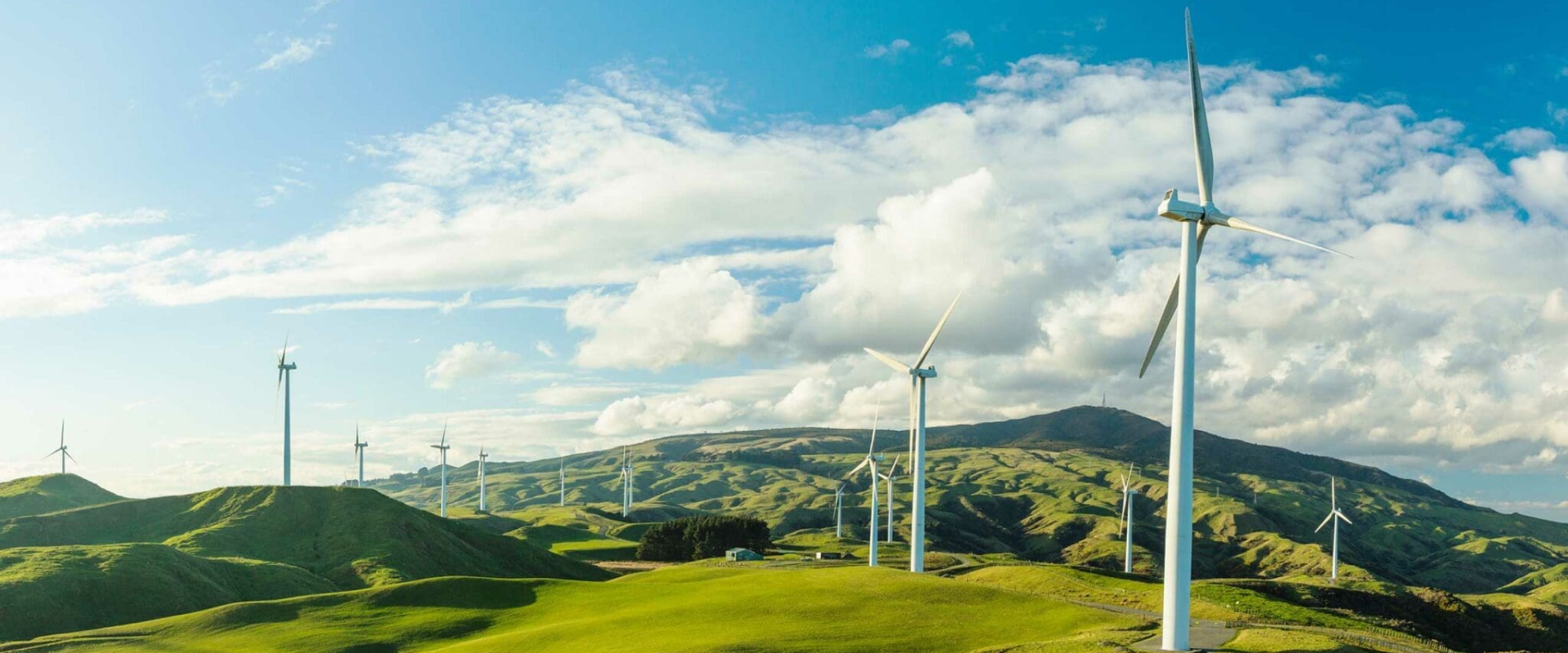
Investing in Green Buildings: Not a Cost, but a Long-Term Strategy
Today, many developers still believe that investing in green constructions means spending significantly more than on conventional buildings. However, practical experience in Vietnam and around the world shows that this initial investment should not be viewed as an additional expense, but rather as a long-term investment strategy that helps reduce operating costs, increase asset value, and enhance the competitiveness of a project.
What Is a Green Construction?
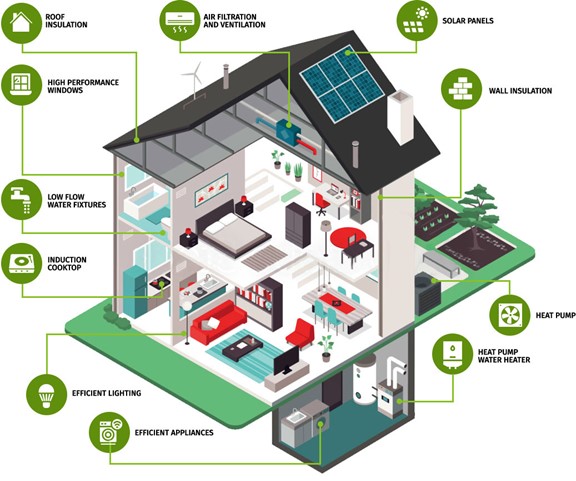
A green construction is a building that is designed, constructed, and operated to use energy, water, and resources efficiently, while reducing environmental impacts and improving the quality of living and working spaces. Today, certification systems such as EDGE, LEED, BREEAM, and Green Mark … are widely applied international standards used to assess how “green” a building is.
Common Misconceptions About Green Constructions
Many developers still assume that green buildings are only suitable for high-end projects and require substantial investment costs. However, this is an incomplete understanding. When green building solutions are integrated from the design stage, they usually increase the initial investment cost only slightly, while delivering long-term benefits such as lower operating costs, higher asset value, greater ability to attract tenants, and better alignment with ESG and sustainable development requirements.
So, in practice, how much more does a developer need to invest to develop a green construction? And does this initial investment truly bring long-term economic benefits?
How Much Does the Investment Cost Increase?
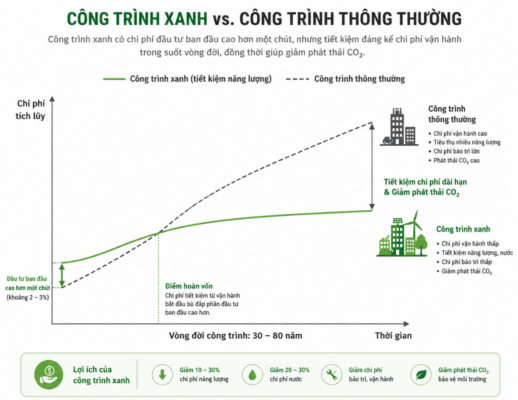
Many studies and real-world projects show that when green solutions are integrated from the design stage, additional investment costs typically range from only 1–5%, depending on the certification target and project scale. In return, developers can gain benefits throughout the building’s life cycle, which may last for decades. The key point is that a green building is not simply about using “green” materials, but about optimizing the entire design, construction, and operation process to achieve higher efficiency.
Saving Operating Costs Throughout the Building Life Cycle
Solutions such as optimizing building orientation, enhancing natural ventilation, using high-performance glazing, energy-efficient air-conditioning systems, LED lighting, water-saving sanitary fixtures, and smart building management systems can significantly reduce:
- Electricity costs;
- Water consumption costs;
- Maintenance and equipment replacement costs;
- Operating costs of technical systems.
For factories or office buildings with high energy consumption, these savings can amount to billions of VND per year. Over time, the total savings often far exceed the additional upfront investment.
Increasing Real Estate Value
A building certified under green standards such as EDGE, LEED, BREEAM, or Green Mark often has higher commercial value because it meets international standards for environmental performance, health, and resource efficiency.
For rental projects, green buildings offer many advantages:
- Attracting high-quality tenants;
- Increasing occupancy rates;
- Maintaining stable rental prices;
- Increasing asset value upon transfer or sale.
An increasing number of multinational corporations prioritize offices, factories, and logistics facilities with green building certification in order to meet ESG targets and reduce carbon emissions across their supply chains.
Improving Access to Green Finance
Financial institutions and banks are increasingly offering preferential programs for projects that meet sustainable development criteria. A project designed and operated according to green building standards may have better access to:
- Green credit;
- Green bonds;
- Sustainable investment funds;
- Funding from international financial institutions.
This not only helps reduce the cost of capital but also enhances the developer’s credibility in the market.
Meeting ESG Trends and Market Requirements
Sustainable development is no longer just an option; it is becoming a requirement for many businesses. International corporations are paying increasing attention to the carbon footprint of buildings, energy efficiency, and environmental impacts across the entire value chain. Investing in green buildings helps developers:
- Meet ESG requirements from clients and investors;
- Increase the ability to attract FDI enterprises;
- Enhance brand image;
- Reduce risks amid increasingly stringent environmental regulations.
Green Constructions Are Investments That Create Value
If viewed only from the perspective of initial construction costs, green buildings may require developers to allocate an additional budget. However, when assessed across the full life cycle of the building, this investment delivers long-term value by reducing operating costs, increasing asset value, attracting tenants, and improving access to finance.
Instead of focusing solely on the initial investment required to develop a green building, developers should evaluate the total cost and value that the building generates throughout its operational life cycle. From this perspective, a green building is no longer an additional cost, but an investment that creates sustainable value.
For consultation on green buildings, please contact us via hotline: 033.2268.626 / 0866.059.659.