Greenhouse Gas Inventory: Data Gaps and What Businesses Need to Prepare
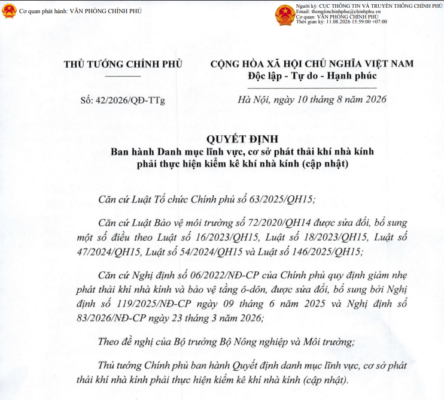
Vietnam’s updated list of facilities required to conduct greenhouse gas (GHG) inventories in 2026 has taken effect. However, data availability remains a major challenge. Decision No. 42/2026/QD-TTg identifies 2,441 facilities subject to mandatory GHG inventories, while the national statistics authority has proposed adding 217 new statistical indicators to address existing data gaps, with an implementation roadmap extending to 2030.
For businesses, these developments are closely connected: regulatory obligations are now clearly defined, while the methods for collecting and standardizing inventory data continue to evolve. This article outlines the key developments and practical steps businesses can take to prepare.
Which Businesses Are Required to Conduct GHG Inventories Under the 2026 List?
A total of 2,441 facilities are included in Vietnam’s updated 2026 list and are required to conduct greenhouse gas inventories. The list was issued under Decision No. 42/2026/QD-TTg, which took effect on September 25, 2026.
| Responsible Ministry | Number of Facilities |
|---|---|
| Ministry of Industry and Trade | 1,916 |
| Ministry of Construction (53 transport facilities and 411 construction facilities) | 464 |
| Ministry of Agriculture and Environment | 61 |
| Total | 2,441 |
The six sectors subject to GHG inventory requirements are energy; transport; construction; industrial processes; agriculture, forestry and land use; and waste.
Facilities included in the list must conduct GHG inventories in accordance with guidance issued by the Ministry of Agriculture and Environment, the Ministry of Industry and Trade, or the Ministry of Construction, as applicable. They must then prepare and submit inventory reports in compliance with Decree No. 06/2022/ND-CP, as amended and supplemented by Decree No. 119/2025/ND-CP and Decree No. 83/2026/ND-CP.
Provincial and municipal People’s Committees are responsible for urging facilities within their jurisdictions to comply and ensuring the accuracy of their respective local lists.
GHG Inventory Data Gaps: Where Are the Main Challenges?

Data currently available for GHG inventories largely supports only Tier 1 methodologies, while activity data remains unavailable for numerous emission sources.
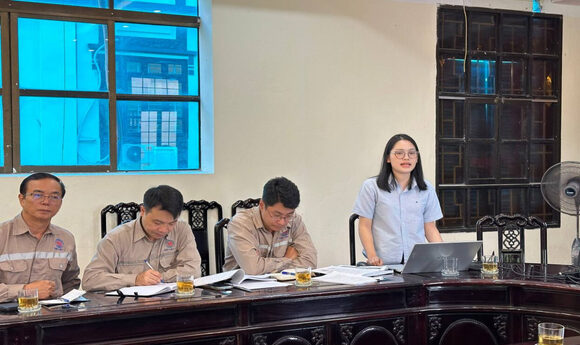
This assessment was presented by Ms. Do Thi Hong, Deputy Head of the Social and Environmental Statistics Department under the National Statistics Office of Vietnam, Ministry of Finance, at a workshop on strengthening data management capacity under the Enhanced Transparency Framework (ETF) of the Paris Agreement.
According to the statistics authority, the major data limitations across sectors include:
-
Overall data availability: Data lacks sufficient disaggregation, country-specific emission factors have not yet been developed, and data reliability remains limited, particularly in agriculture, forestry, land use, and waste.
-
Energy: Inventory calculations currently rely on default emission factors provided by the Intergovernmental Panel on Climate Change (IPCC). The primary data source is the energy balance compiled by the Ministry of Industry and Trade, but detailed information remains unavailable for several subsectors.
-
Industrial processes: Of eight subsectors, five have only partial data, while three lack data entirely: the electronics industry, production and use of other products, and other industrial processes. Some emission factors currently in use are also outdated.
-
Construction: Data is unavailable for bricks and roof tiles, ceramic tiles, dimension stone, and roofing sheets. Import and export statistics for clinker also remain inconsistent. Notably, according to the statistics cited in the original report, Vietnam ranks third globally in cement production.
-
Transport: Data gaps remain in international aviation, international maritime transport, fishing activities, pipeline transport, and off-road vehicles.
Meanwhile, the Enhanced Transparency Framework requires GHG inventory results to be complete, accurate, consistent, and transparent. It also emphasizes the use of country-specific emission factors and uncertainty assessments.
217 Proposed New Statistical Indicators and the Roadmap to 2030
Vietnam’s statistics authority has proposed introducing 217 additional statistical indicators across the six GHG inventory sectors, with implementation divided into two phases through 2030. These indicators are currently proposals and have not yet been adopted as binding regulations.
The industrial processes sector accounts for the largest number of proposed indicators, with 106, while the waste sector has the fewest. Importantly, 175 of the 217 proposed indicators—more than 80%—are not currently available from any existing data source and would require entirely new data collection mechanisms.
| Implementation Period | Number of Indicators | Key Priorities |
|---|---|---|
| 2025–2027 | 87 | Major emission sources that are easier to monitor; sectors with established infrastructure and reporting systems; businesses with sufficient technical and financial capacity. |
| 2028–2030 | 130 | Dispersed emission sources that are difficult to monitor; areas requiring substantial investment in infrastructure and capacity building; emerging technologies. |
To implement the proposed framework, the statistics authority has outlined four key measures:
-
Further develop and strengthen the National Greenhouse Gas Inventory System.
-
Establish a standardized set of statistical indicators for the six sectors, together with consistent reporting templates and instructions.
-
Clearly assign data provision responsibilities for each indicator, given the involvement of multiple ministries and government agencies across sectors.
-
Integrate missing indicators and data disaggregation requirements into the statistical indicator systems of relevant ministries and sectors.
What Should Businesses Prepare Now?

Businesses do not need to wait until the statistical indicator system is fully developed before preparing their GHG inventory data. Many of the current gaps result from insufficiently detailed activity data, making early preparation particularly valuable.
The following practical steps provide general guidance and do not replace official instructions issued by the competent authorities:
-
Verify whether your facility is included in the 2026 list. Review the list issued under Decision No. 42/2026/QD-TTg and identify the responsible ministry—Industry and Trade, Construction, or Agriculture and Environment—to determine which sector-specific guidance applies.
-
Define the inventory boundaries and emission sources. Identify relevant sources, including fuel consumption, electricity use, industrial processes, transport activities, and waste generation.
-
Collect detailed activity data. Where possible, organize data by fuel type, production line, or month rather than relying solely on aggregated figures.
-
Maintain complete supporting documentation. Retain original records, including electricity bills, fuel invoices, and production output records, to ensure data traceability when required.
-
Assign a responsible team or contact person. Establish clear internal responsibilities for GHG inventory preparation and regularly monitor new guidance issued by the relevant ministry.
CIC and Net Zero 2050: Supporting Businesses on Their Sustainability Journey
Net Zero 2050 is CIC’s sustainability consulting brand, supporting businesses on their journey toward net-zero emissions. Its consulting services currently cover green building certification, Life Cycle Assessment (LCA) and Environmental Product Declarations (EPD), and carbon credits.
CIC Construction Technology and Consultancy Joint Stock Company provides technology consulting and software solutions for the architecture, engineering, and construction (AEC) industry.
With 411 construction facilities included in the 2026 mandatory GHG inventory list, emissions data related to construction materials and construction activities is particularly relevant to the businesses and industry professionals CIC serves.
Get in touch with our team. If your facility is included in the mandatory GHG inventory list or your business is planning to prepare for greenhouse gas inventory requirements, contact us to discuss data collection, reporting processes, and potential emissions reduction pathways.
-
Hotline: 0866 059 659 – 033 226 8626
-
Email: info@cic.com.vn
-
Website: www.netzero2050.vn | www.cic.com.vn
References:
Government Electronic Newspaper – 2,441 Facilities Required to Conduct Greenhouse Gas Inventories