Which Building Materials Require Energy Labels Under Circular 81/2026?
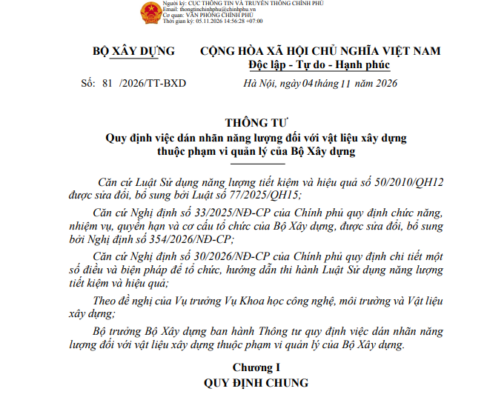
In Vietnam, energy labeling will become mandatory on January 1, 2029, for covered types of building glass, emulsion wall paints used on building envelopes, and metal roofing and cladding sheets. The requirement will apply from January 1, 2031, to foam insulation boards, certain unfired masonry products, and ceiling and partition boards. Vietnam’s Ministry of Construction issued Circular No. 81/2026/TT-BXD on November 4, 2026. It takes effect on January 1, 2027.
Three dates businesses need to track
| Date | What applies |
|---|---|
| January 1, 2027 | The Circular takes effect. Businesses may voluntarily declare and label products before the mandatory date for their group, following the Circular’s testing, declaration, and labeling rules. |
| January 1, 2029 | Energy labeling becomes mandatory for Group 1 products listed in Appendix I. |
| January 1, 2031 | Energy labeling becomes mandatory for Group 2 products listed in Appendix I. |
Products manufactured in Vietnam or cleared through import procedures before the applicable deadline may remain on the market without an energy label if the business can document when they were manufactured or imported. Keep records by batch, especially for inventory held around the transition dates.
Covered materials and testing requirements
Appendix I lists six material categories. Check each product type against the appendix and confirm its intended use, particularly for paints and roofing products with thermal insulation properties. The table uses shortened product names for reference.
| Group and start year | Covered materials | Property to declare | Test standard |
|---|---|---|---|
| Group 1 · 2029 | Building glass. Float glass, horizontally or vertically drawn sheet glass, patterned rolled glass, flat tempered glass, laminated glass and laminated safety glass, low-E glass, reflective glass, sealed insulating glass units, heat-absorbing tinted glass, switchable glass, photovoltaic-integrated glass, and wired glass. | g-value or SHGC, as specified by the applicable standard. | TCVN 7737:2023 (ISO 9050). |
| Group 1 · 2029 | Emulsion wall paints used on building envelopes. | Solar Reflectance Index (SRI). | TCVN 14358:2025 (ASTM E1980). |
| Group 1 · 2029 | Metal roofing and cladding sheets. | SRI for roofing surfaces or coatings directly exposed to solar radiation. Thermal conductivity (λ) for insulating roofing products in block or panel form. | SRI under TCVN 14358:2025 (ASTM E1980). λ under TCVN 14356:2025 or TCVN 14357:2025. |
| Group 2 · 2031 | Foam insulation boards, including polystyrene and polyurethane boards. | λ | TCVN 14356:2025 or TCVN 14357:2025. |
| Group 2 · 2031 | Unfired masonry products. Autoclaved aerated concrete (AAC) blocks, reinforced AAC wall panels, extruded precast hollow-core concrete wall panels, three-layer lightweight sandwich wall panels, lightweight concrete blocks, and lightweight concrete panels. | λ | TCVN 14356:2025 or TCVN 14357:2025. |
| Group 2 · 2031 | Ceiling and partition boards. Gypsum boards, fiber-reinforced gypsum panels, glass-fiber gypsum panels, cement-bonded boards, and composite boards. | λ | TCVN 14356:2025 or TCVN 14357:2025. |
The g-value or solar heat gain coefficient (SHGC) indicates the fraction of incident solar energy that enters through glazing. SRI reflects how well a surface reflects solar radiation and emits heat. λ is thermal conductivity, expressed in W/(m·K) and measured under TCVN 14356:2025 (ISO 8301) or TCVN 14357:2025 (ISO 8302). For example, a declaration for low-E glass uses the g-value or SHGC, while one for a polyurethane foam board uses λ.
What should manufacturers and importers prepare?

- Create an inventory by product code. Record the trade name, product identifier, construction, main raw materials, manufacturing site, applicable group, and property to declare. For imported products, request technical documents that match the actual product codes and retain records showing when import procedures were completed.
- Select a testing laboratory and prepare representative samples. For Vietnamese laboratories, check the Ministry of Construction’s published list and confirm that the laboratory’s scope covers the material, property, and test method. For foreign laboratories, verify ISO/IEC 17025 accreditation by an accreditation body that is a signatory to the ILAC MRA or APAC MRA. Businesses are responsible for ensuring their samples are representative.
- Prepare the four required documents. These are the technical specifications identifying the product type and declared thermal properties, the thermal test results, the energy labeling declaration using Form No. 01 in Appendix II, and the proposed label based on Appendix III. The label shows the business details, product name and code, declared property and value, test standard, and an electronic lookup code where applicable.
- Submit the declaration before placing the products on the market. Follow the deadline for the applicable product group. Submit the documents electronically to the Ministry of Construction and publish the declaration on the company website. After declaring, affix or print the label on the product or its packaging. The Ministry receives and publishes the information, and the business remains responsible for the accuracy of the declaration and the product’s conformity. Changes to product construction, main raw materials, manufacturing technology, or the manufacturing site require retesting and a new declaration.
What do energy labels and EPDs report?
An energy label reports the thermal properties specified for each material. An Environmental Product Declaration (EPD) provides data on a product’s environmental impacts across its life cycle. An insulation board manufacturer, for example, can use thermal conductivity test results for its energy labeling declaration and prepare an EPD if customers require life-cycle environmental data.
Need to prepare environmental data for your building materials? Contact Net Zero 2050 to request LCA and EPD consulting.
Hotline: 0866 059 659 – 033 226 8626
Email: info@cic.com.vn